
How Do We Know Whether What We See, Hear, and Read Online Is Real?
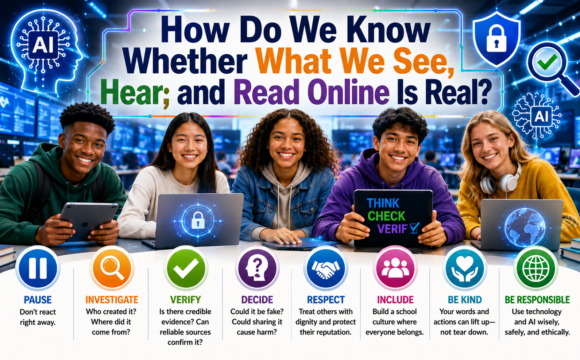
Imagine receiving a video of a classmate saying something offensive, a voice message that sounds exactly like someone you know, or a photograph showing an event that never happened. In today’s rapidly changing digital world, artificial intelligence (AI) can make each of these situations appear remarkably real. With the beginning of the 2026–2027 academic year, students are entering classrooms where AI continues to transform how they learn, communicate, research, and create. While AI offers exciting educational opportunities, it also presents a growing challenge for students and families: How do we know whether what we see, hear, and read online is real?
Artificial intelligence can help students generate ideas, explore subjects, improve writing, analyze information, and prepare for future careers. However, the same technology can be misused to create deepfakes, cloned voices, manipulated photographs, fabricated information, and other deceptive digital content that may embarrass, impersonate, harass, or cyberbully others.
For generations, people often trusted photographs, videos, and voice recordings as evidence that something actually happened. AI has changed that assumption. A deepfake can make it appear that someone said or did something that never occurred. Voice-cloning technology can imitate another person’s voice, while AI-generated images can place individuals in situations that never happened. For students, these technologies raise serious concerns about truth, privacy, reputation, consent, bullying, and personal responsibility.
Before forwarding a questionable photograph, video, audio recording, or social media post, students should remember four important words: Pause – Investigate – Verify – Decide. They should ask: Who created this? Is there credible evidence supporting it? Can reliable sources confirm it? Could it have been digitally manipulated? Could sharing it harm another person?
AI misuse also creates new opportunities for cyberbullying. A student can use artificial intelligence to create a fake photograph of a classmate, imitate someone’s voice, fabricate an embarrassing video, or generate false information. Students who forward or repost harmful material can contribute to the damage even when they did not create it. Responsible students should refuse to participate, preserve relevant evidence when appropriate, report harmful content, and seek assistance from a trusted adult.
Families and schools share responsibility for preparing students for this changing digital environment. Parents can discuss AI-generated content, privacy, responsible sharing, and appropriate technology use at home. Schools can provide instruction in AI ethics, deepfakes, voice cloning, image manipulation, misinformation, AI bias, privacy, academic integrity, cyberbullying, and responsible innovation.
These topics are addressed in the new National Online Bullying & Cyberbullying Prevention Curriculum, created by Dr. Ronald Holmes for high school students in grades 9–12. The goal is not to teach students to fear artificial intelligence, but to prepare them to understand it, question it, verify it, use it responsibly, and refuse to use it to harm others.
As America’s students return to school, digital judgment must become an essential part of their education. Knowing how to create something with AI does not mean it should be created. Knowing how to share something does not mean it should be shared. Also, seeing or hearing something online does not automatically make it true.
Before you believe it, before you post it, and before you share it, ask one important question: Is it real, and have I verified it? For additional information about the National Online Bullying & Cyberbullying Prevention Curriculum, please contact Dr. Ronald Holmes at [email protected].
Dr. Ronald Holmes is the author of 33 books and publisher of “The Holmes Education Post,” an education focused Internet newspaper. Holmes is a former teacher, school administrator, test developer and district superintendent. Holmes has written children’s books on the coronavirus, solar system, flowers, colors, careers, continents, animals, birds and school bullying. His adult books focus on religion, relationships, hazing, workplace bullying, bipolar disorder, health and fitness, educational reform, and navigating the dissertation process.
Leave a Comment
Partners
