
Is it Time for Prime Time?
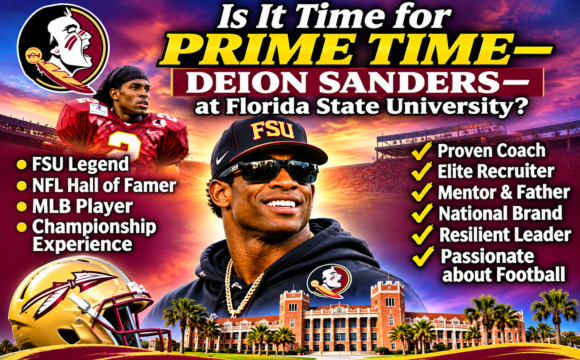
At a defining moment in the history of Florida State University (FSU) football, one compelling question deserves serious consideration: Is it time for Prime Time? Following the university’s November 1, 2026, decision to part ways with head football coach Mike Norvell, FSU has launched a national search for a leader capable of restoring championship expectations, energizing its fan base, attracting elite athletes, and competing in the rapidly changing world of college athletics. The answer may lie in one of the most electrifying athletes ever to wear the garnet and gold: Deion “Coach Prime” Sanders.
Few individuals possess the extraordinary athletic credentials of Sanders. As a three-sport athlete at Florida State, he excelled in football, baseball, and track and field, becoming a two-time unanimous All-American and winning the prestigious Jim Thorpe Award in 1988. Under legendary coach Bobby Bowden, Sanders helped establish the Seminoles as a national football powerhouse. His professional accomplishments were equally remarkable. During 14 NFL seasons, he earned eight Pro Bowl selections, nine first-team All-Pro honors, two Super Bowl championships, and induction into the Pro Football Hall of Fame in 2011. He also competed in Major League Baseball, appearing in the 1992 World Series and becoming the only athlete to play in both a Super Bowl and a World Series. Sanders does not simply understand championship excellence; he has lived it at virtually every level of athletic competition.
Yet the most compelling argument for Sanders extends beyond championships, trophies, and individual honors. As a father, mentor, and coach, he has demonstrated a commitment to developing young men both on and off the football field. His guidance of sons Shedeur and Shilo Sanders, along with his mentorship of Heisman Trophy winner Travis Hunter, illustrates his investment in athletic development, personal discipline, accountability, and preparation for life beyond college. Through passionate motivational speeches, candid conversations, and an unmistakable belief in his players’ potential, Sanders challenges young men to pursue greatness rather than settle for mediocrity. His philosophy emphasizes confidence, character, preparation, and the responsibility to become productive men, not merely successful football players.
His coaching accomplishments also deserve recognition. At Jackson State University, Sanders compiled a 27–6 record, captured consecutive Southwestern Athletic Conference championships, and brought unprecedented national attention to historically Black colleges and universities. At Colorado, he inherited a football program that had finished 1–11 in 2022 and transformed it into a nine-win team in 2024, with national recognition and a Heisman Trophy winner. His arrival generated extraordinary media coverage, increased interest in the university, and demonstrated his remarkable ability to attract high-profile talent. These accomplishments underscore an essential point: Coach Prime has already demonstrated that his presence can change the national conversation surrounding a university’s football program.
That influence is particularly important in today’s competitive college football environment. With Name, Image, and Likeness (NIL) opportunities, revenue sharing, transfer portal movement, and intense recruiting competition reshaping Division I football, universities must offer more than attractive facilities and traditional promises of success. They must provide visibility, opportunity, credibility, and a compelling vision. Sanders possesses an internationally recognizable personal brand, relationships throughout professional sports, and an extraordinary ability to capture national attention. For elite high school athletes and transfer prospects seeking exposure, personal development, and preparation for professional careers, his presence at FSU could become a significant recruiting advantage. For the university, that same marketability could strengthen national media interest, alumni engagement, donor enthusiasm, corporate partnerships, and the broader economic appeal of Seminole football. These opportunities are not guaranteed, but they represent powerful advantages worthy of consideration.
Critics will undoubtedly point to Sanders’ uneven record at Colorado, including a disappointing 3–9 season in 2025 and a 4–6 record through November 13, 2026. Those concerns deserve acknowledgment, but they should not overshadow the larger picture of his leadership, recruiting success, and program-building potential. In fact, Colorado’s stunning 42–32 victory over No. 14 Houston on November 13, its first win against a top-15 opponent since 2007, demonstrated the resilience and competitive spirit Sanders continues to instill in his players. A coach should be evaluated not only by the losses he has experienced, but also by the obstacles he has overcome, the talent he has developed, the opportunities he has created, and the future he is capable of building. FSU must assess coaching strategy and sustained performance, but it should also recognize that Sanders brings qualities extending far beyond a single season’s win-loss record.
Perhaps no experience better demonstrates Sanders’ extraordinary determination than his personal battle with bladder cancer in 2025. After undergoing major surgery, including removal of his bladder, and confronting serious health challenges, Sanders returned to coaching with remarkable courage and determination. In June 2026, he publicly announced that he was cancer-free. His recovery represents more than a personal victory; it offers a powerful lesson to every student-athlete facing adversity. When life presented him with obstacles, he demonstrated resilience; when his health presented uncertainty, he demonstrated courage; and when challenges threatened his future, he demonstrated the determination to keep moving forward. That is the kind of leadership that can inspire athletes to overcome adversity in football, education, and life.
Florida State now faces a decision that extends beyond selecting its next football coach. It must determine who can restore confidence, rebuild a championship culture, compete for America’s best athletes, and position the Seminoles for long-term success in a changing college sports landscape. Sanders’ existing contract with Colorado and his publicly expressed commitment to that university make his availability uncertain, and there is no assurance that he would accept an opportunity at FSU. Nevertheless, the university’s national search should seriously consider what his experience, passion, influence, and leadership could contribute to its future. The Seminoles need more than recognition of past greatness; they need a compelling vision for tomorrow.
So, is it time for Prime Time at Florida State University? When considering his extraordinary athletic accomplishments, his passion for developing young men, his demonstrated ability to recruit elite talent, his national marketability, his motivational leadership, and his remarkable resilience in the face of adversity, the answer becomes compelling. Florida State has an opportunity to reconnect its championship tradition with a dynamic vision for the future. It is time to bring the excitement back, time to restore the expectation of excellence, time to compete for the nation’s best athletes, and time to give serious consideration to one of the greatest Seminoles ever to wear the uniform. Yes, it is time for Prime Time!
Dr. Ronald Holmes is the author of 33 books and publisher of “The Holmes Education Post,” an education focused Internet newspaper. Holmes is a former teacher, school administrator, test developer and district superintendent. Holmes has written children’s books on the coronavirus, solar system, flowers, colors, careers, continents, animals, birds and school bullying. His adult books focus on religion, relationships, hazing, workplace bullying, bipolar disorder, health and fitness, educational reform, and navigating the dissertation process.
Leave a Comment
Partners
