
Is It Time to Teach Bible Study in America’s Public Schools?
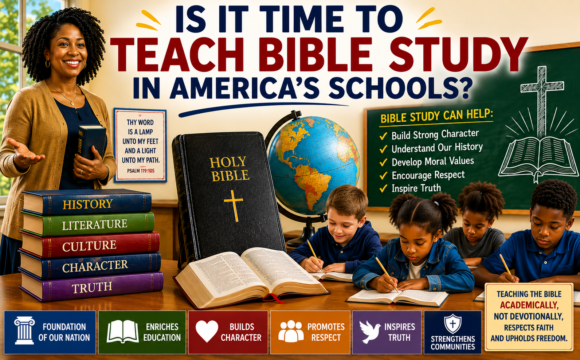
A growing national debate is asking an important question: Is it time to teach Bible study in America’s public schools? Recent actions in Texas and several other states have renewed conversations among educators, parents, lawmakers, and faith leaders concerning the role of the Bible in public education. While proponents believe biblical instruction can strengthen students’ understanding of history, literature, ethics, and moral character, opponents warn that government-sponsored religious instruction may conflict with the constitutional principle separating church and state.
The State of Texas has become the focal point of this national discussion. In 2024, the Texas State Board of Education approved Bluebonnet Learning, an optional elementary curriculum that incorporates biblical stories and references into reading and language arts instruction. In June 2026, the Board approved a statewide required reading list that includes Bible passages and Bible-based literature for students beginning in 2030. Proponents maintain that these materials present the Bible from a historical and literary perspective, while opponents argue that the curriculum places disproportionate emphasis on Christianity and may influence religious beliefs rather than simply educate students about religion.
The current debate also reflects America’s educational history. During the nineteenth and early twentieth centuries, Bible reading and prayer were common practices in many public schools and were widely viewed as part of moral and civic education. However, following a series of United States Supreme Court decisions in the 1960s—most notably Engel v. Vitale (1962) and Abington School District v. Schempp (1963)—state-sponsored prayer and devotional Bible reading were removed from public schools because the Court concluded that such practices violated the Establishment Clause of the First Amendment.
Texas is not alone. States such as Oklahoma, Tennessee, and West Virginia have expanded opportunities for students to study the Bible through elective courses, released-time religious instruction, or academically based Bible classes that emphasize history, literature, and cultural influence rather than devotional teaching. These programs generally seek to comply with constitutional requirements by remaining voluntary, academically focused, and non-sectarian, although each continues to generate legal and public debate.
Proponents present several compelling reasons for teaching Bible study in schools. They argue that students gain a richer understanding of American history, world civilization, and classic literature; they develop greater appreciation for the biblical references found throughout art, music, law, and public discourse; and they strengthen character by examining timeless principles such as honesty, compassion, forgiveness, justice, and personal responsibility. They further contend that studying the Bible academically promotes cultural literacy, encourages respectful dialogue, and prepares students to understand the religious traditions that have influenced civilizations throughout history.
Opponents raise equally significant concerns. They argue that public schools should educate without promoting any particular faith, should respect students from diverse religious backgrounds, and should protect families’ constitutional right to direct their children’s religious education. Critics also express concern that Bible instruction could unintentionally favor one denomination over another, marginalize students of other faiths or no faith, and expose school districts to costly constitutional litigation.
At the center of the controversy lies the First Amendment to the United States Constitution. While courts have consistently ruled that public schools may teach about the Bible as history, literature, and culture, they have also maintained that schools may not sponsor religious worship, encourage religious conversion, or endorse one faith over another. Consequently, the legal distinction remains clear: educators may teach religion academically, but they may not teach religion devotionally. This constitutional balance continues to shape legislative proposals, school board decisions, and courtroom challenges across the nation.
As this national conversation continues, communities across America will ultimately decide whether Bible study belongs in public education and, if so, under what constitutional safeguards. Regardless of one’s position, the discussion reminds citizens that education must continue to promote knowledge, preserve liberty, and respect both religious freedom and constitutional principles. Whether viewed as a historical document, a literary masterpiece, or the inspired Word of God, the Bible remains one of the most influential books ever written, and its place in America’s classrooms will likely remain a subject of thoughtful discussion for years to come.
In the meantime, those who desire to explore the Bible in a church setting are invited to join me online as I facilitate our next Bible study through First Timothy Baptist Church’s website, YouTube or Facebook on Wednesday, July 29, at 7:00 p.m. (EST). Our lesson, “The Truth that Makes Us Free,” is found on pages 13–18 of Beyond the Sunday Sermon (2nd Edition) and is based on John 8:30–33 and John 14:6. Together, we will examine the source of the truth, the Spirit of the truth, and the strength of the truth as we discover how the truth found in Jesus Christ brings genuine freedom.
Dr. Ronald Holmes is the author of 33 books and publisher of “The Holmes Education Post,” an education focused Internet newspaper. Holmes is a former teacher, school administrator, test developer and district superintendent. Holmes has written children’s books on the coronavirus, solar system, flowers, colors, careers, continents, animals, birds and school bullying. His adult books focus on religion, relationships, hazing, workplace bullying, bipolar disorder, health and fitness, educational reform, and navigating the dissertation process.
Leave a Comment
Partners
